Getting started
Connecting to your lab environment
Most deliveries of this lab (Cisco Live, TechAdvantage, customer workshops, internal enablement) run on Cisco dCloud - a shared demo/lab cloud where a session pod hosts the four IOS XE devices, the ISP router, GitLab, and the Windows 10 / Ubuntu workstations you interact with. If your presenter has shared a dCloud session URL with you, follow these three steps to open the Windows 10 VM where you'll do all your work.
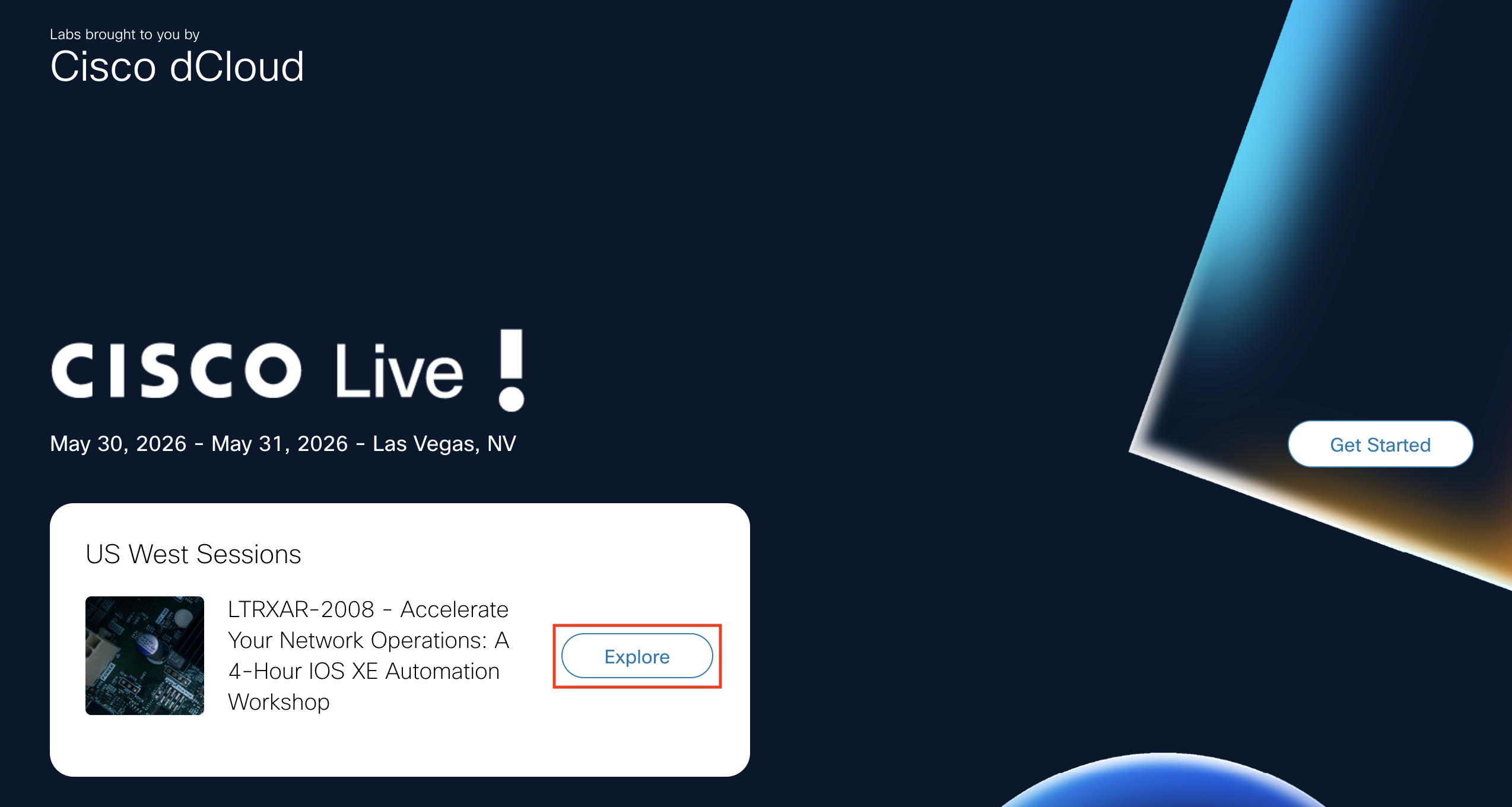
Step 1 - Click Explore. Open the dCloud session URL your presenter shared and click the Explore hyperlink on the session card.
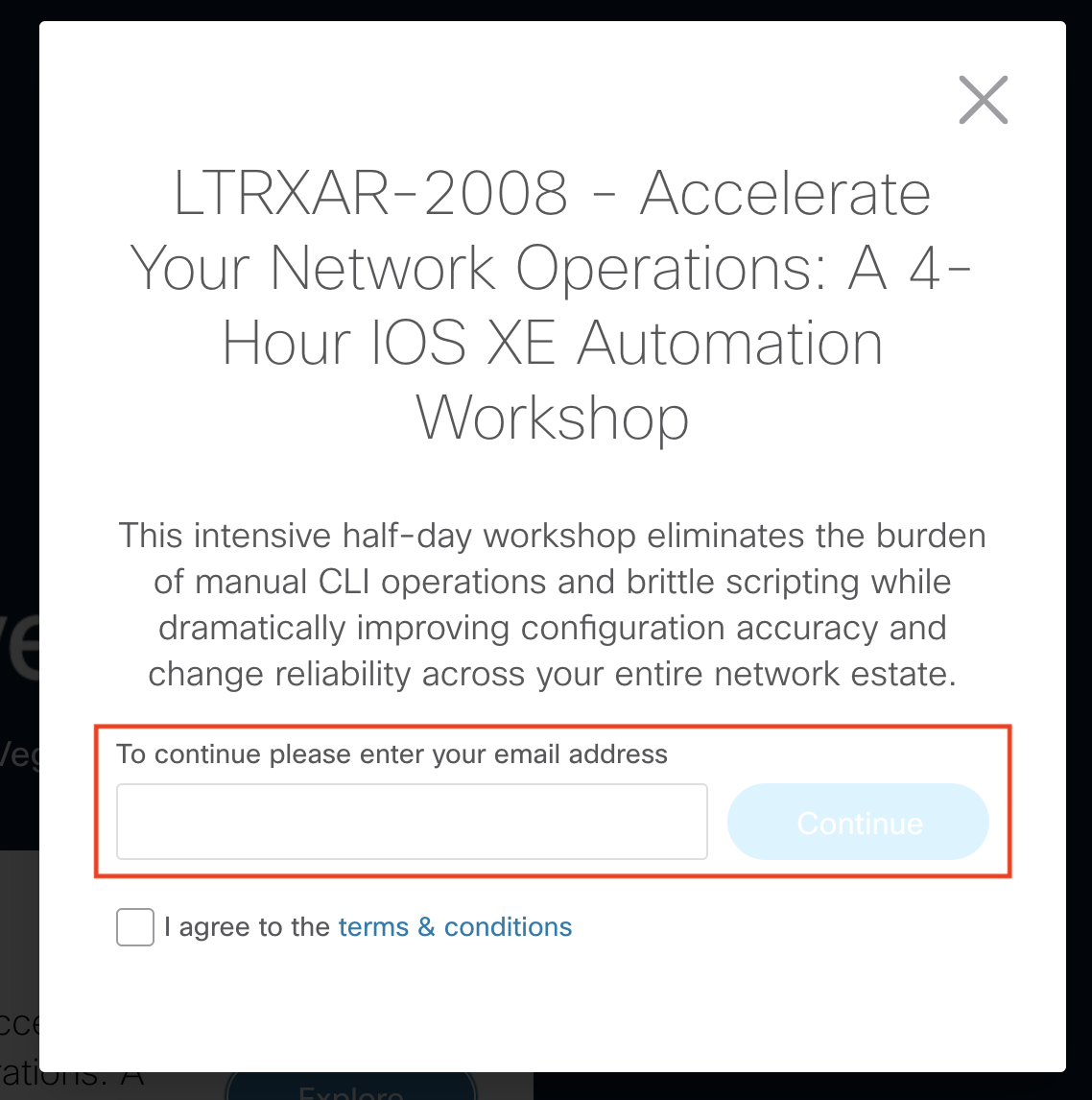
Step 2 - Enter your email. In the dialog that appears, type the email address associated with your Cisco account (or the one you registered with for the event) and click Continue.
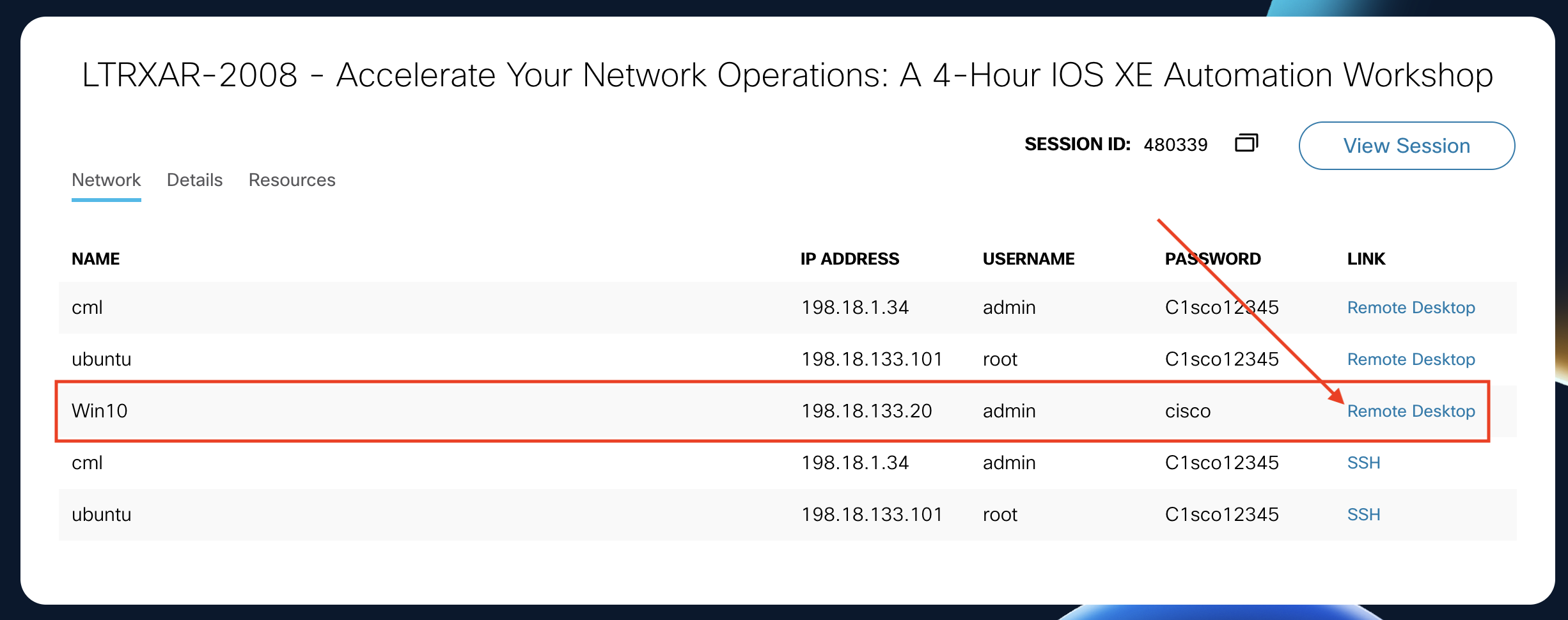
Step 3 - Open the Win10 Remote Desktop. You'll see a resource details page listing the virtual machines in your lab pod. Find the row for Win10 and click the Remote Desktop link - this opens a Web RDP session directly in your browser.
Once the Web RDP session loads, you're inside the lab VM. Everything you need - VS Code, Solar-PuTTY, WSL Ubuntu, and Chrome - is already installed. You'll open the WSL Ubuntu terminal frequently throughout the lab; it's the orange Ubuntu icon on the desktop labelled Ubuntu 22.04.5 LTS.
Not running on dCloud?
If you're delivering this lab on your own infrastructure (physical IOS XE devices, CML, or another virtualization stack) with your own workstation, skip the pod-specific onboarding above. Point the toolchain at your devices, confirm SSH + NETCONF reachability, and pick up from Task 01. The Topologies page documents the device inventory and IP plan the lab tasks assume - mirror that (or adjust the intent YAML) and everything else follows.
For the full topology diagram and device inventory, see Topologies (also linked from the top navigation bar throughout the lab).
How the tasks flow
Tasks are sequential - each builds on the previous one
The Recommended path (Tasks 01 through 06, then 10, 12, 13) is designed to be followed in order. Each task uses configuration, files, or state produced by earlier tasks. Skipping a task means the next one's instructions won't match what's on your disk.
Optional tasks (07-09 Templates, 11 Post-checks, 14 Extended pipeline, 15 Merge requests) can be cherry-picked based on your interest and remaining time. Where the order of optionals matters (e.g. Task 11 must run before Task 12 destroys its artifacts), the affected task page has its own callout at the top.
If you have ~90 minutes only: Tasks 01 -> 02 -> 03 -> 05 -> 06 -> 10 -> 12 -> 13 gets you through the full "write intent, validate, deploy via CI/CD" loop. Skip Task 04 and all Optional tasks.
Readiness check (2 minutes, before Task 01)
Before sinking time into the first task, confirm the lab's three moving pieces are actually reachable. Open the WSL Ubuntu terminal - it's the orange Ubuntu icon on the desktop labelled Ubuntu 22.04.5 LTS - and run these three commands:
# 1. Can you reach a lab device over SSH?
ssh -o StrictHostKeyChecking=no cisco@198.18.130.10 "show version | include Cisco IOS"
Warning: Permanently added '198.18.130.10' (RSA) to the list of known hosts.
(cisco@198.18.130.10) Password:

Cisco IOS XE Software, Version 17.15.01
Cisco IOS Software [IOSXE], Catalyst L3 Switch Software (CAT9K_IOSXE), Version 17.15.1, RELEASE SOFTWARE (fc4)
Cisco IOS-XE software, Copyright (c) 2005-2024 by Cisco Systems, Inc.
All rights reserved.  Certain components of Cisco IOS-XE software are

client_loop: send disconnect: Broken pipe
Password prompt or access denied is fine here
The goal of this check is simply that the device responds. If it prompts for a password, SSH is working. If it says Permission denied or drops the connection after login, the device is reachable and healthy. Only flag it to a proctor if the command hangs or times out with no output.
# 2. Can you reach GitLab?
curl -sk https://198.18.133.101 -o /dev/null -w "gitlab HTTP %{http_code}\n"
200 or 302 are both fine
GitLab usually answers the bare host with a 302 redirect (to /users/sign_in) on a freshly-logged-out browser session and a 200 once you've hit it before. Either response means the server is reachable - flag a proctor only if you get a connection timeout, 000, or a 5xx.
If all three produce the expected output, you're ready. If any fails, flag it to a lab proctor now rather than hitting it mid-task.
← Previous: Disclaimer · Next: Task 01 - SSH to Devices